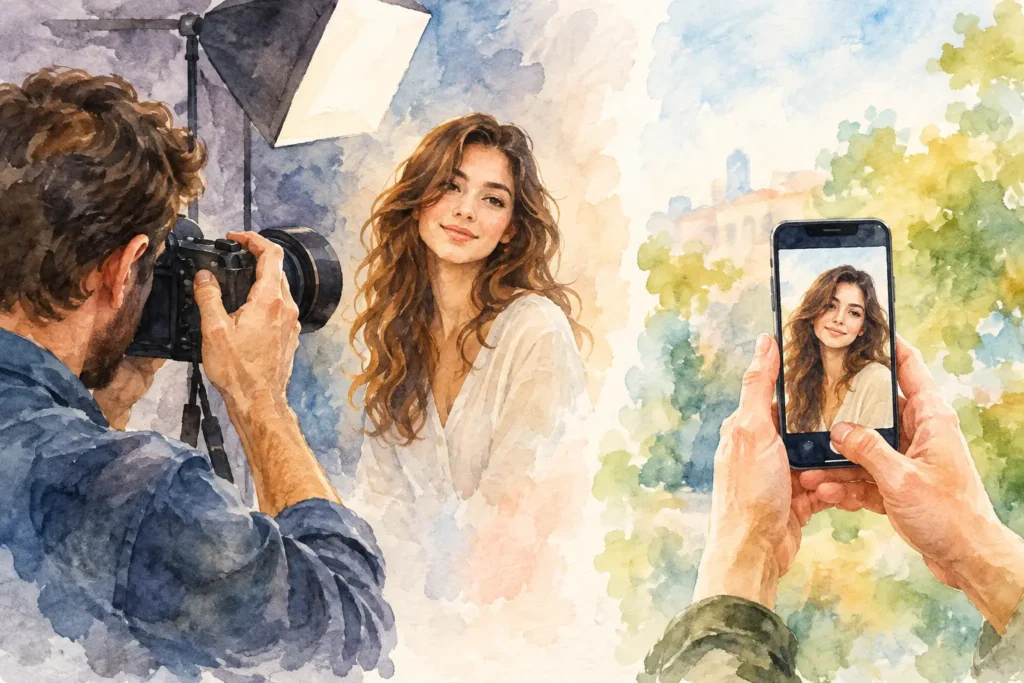
A phone can take a surprisingly good photo. In the right window light, with a clean background and a steady hand, it may even look polished at first glance. But photographer versus smartphone headshots is not really a question of which camera has more megapixels. It is a question of whether the image does the job you need it to do.
For an actor, that job may be earning a closer look from casting. For a professional or entrepreneur, it may be building instant credibility before a first meeting. For a company, it may be showing a cohesive, approachable team. The stakes are different, but the need is the same: people should see the photo and feel they are meeting the real, confident version of you.
Photographer versus smartphone headshots: the real difference
A smartphone is a tool. A professional headshot session is a guided process designed around your goals, your audience, and how you come across on camera.
Modern phones use powerful software to improve exposure, soften skin, blur backgrounds, and enhance color. That can be helpful for casual portraits. It can also make choices for you that are not always flattering or accurate. Skin can look overly smooth, facial proportions can shift at close range, and artificial background blur can create distracting edges around hair, glasses, or clothing.
A photographer makes those decisions intentionally. Lens choice, camera distance, lighting direction, background, framing, and final retouching all affect whether a headshot feels credible and current. More importantly, a photographer watches the expression. The strongest headshots are rarely about a perfect smile. They show presence, ease, and connection.
That is difficult to create when you are balancing a phone, checking a timer, and wondering what your face is doing.
Why a good phone photo can still fall short
The biggest limitation of a smartphone headshot is usually not image quality. It is perspective.
Phones are often held too close to the face. Wide-angle lenses can subtly exaggerate the features nearest the camera, especially the nose, forehead, and jawline. You may not notice the distortion on a small screen, but it can become obvious when the image is cropped for LinkedIn, a company website, a casting profile, or a press mention.
Lighting is another issue. Window light can be beautiful, but it changes quickly and can be harder to control in a New York apartment or office. Overhead lighting often creates shadows under the eyes. Direct sun can cause squinting. A bright window behind you can leave your face dark while the background looks properly exposed.
Then there is the expression problem. Most people have a familiar “photo face” that appears as soon as they know the camera is on them. It may be too serious, too smiley, too guarded, or simply unlike how they look in conversation. Without real-time direction, it is easy to take 80 images and still not find one that feels like you.
The image may be good, but not strategic
A selfie can be warm and personable. A colleague can take a clean portrait on a phone. Neither is automatically wrong. The question is whether the result matches the context in which it will be seen.
An actor needs a headshot that communicates type while leaving room for the viewer to imagine them in a role. A corporate leader may need a photo that feels capable and approachable, not overly casual or stiff. An entrepreneur may need images that work across a website, speaker bio, LinkedIn profile, and media opportunities.
A professionally made headshot is built with those uses in mind. It is not just a flattering image. It is a practical brand asset.
What a professional session adds beyond the camera
The value of working with a photographer is often most visible before the shutter is pressed. A strong session starts with a conversation: Where will the photos be used? Who needs to trust you? What do you want people to notice first? How formal should the result feel?
Those answers guide the session. Wardrobe can be chosen for the camera rather than guessed at in front of a mirror. Backgrounds can support your industry without becoming a distraction. Lighting can be adjusted for your skin tone, facial structure, hair, and the mood you want the image to convey.
Clear direction also changes the experience. Small adjustments to posture, chin position, shoulder angle, and eye line can make a major difference. So can permission to relax. People are often relieved to learn they do not need to know how to pose. They need someone who can see what is working and give honest feedback in the moment.
That collaboration is especially useful for people who say they are not photogenic. Usually, they have not been photographed in a way that gave them enough time, support, or usable direction.
When smartphone headshots are enough
There are situations where a smartphone portrait is perfectly reasonable. If you need a quick image for an internal chat profile, a temporary volunteer page, or a casual personal update, a well-lit phone photo can do the job. It may also be a useful stopgap when you need something immediately and your current headshot is several years old.
If you go this route, keep it simple. Use indirect window light, place the phone at eye level, step back from the camera, and avoid heavy portrait-mode effects. Wear an outfit that matches your professional setting, choose an uncluttered background, and ask someone else to take the photo if possible. A timer selfie tends to look more self-conscious than a portrait made by another person.
Still, a temporary solution should stay temporary when visibility matters. If you are actively job searching, auditioning, pitching clients, updating a leadership page, or preparing a company-wide team refresh, the quality and consistency of your image carry more weight.
When hiring a photographer makes sense
Professional headshots are most valuable when the photo has to work hard for you. That includes career transitions, promotions, executive bios, company websites, personal-brand launches, speaking engagements, auditions, and press opportunities.
For teams, consistency matters just as much as individual quality. A website looks more organized when everyone is photographed with a shared visual approach, even if each person has their own personality and role. Mismatched crops, lighting, backgrounds, and image quality can make a growing company appear less coordinated than it actually is.
For actors, the professional standard is even more direct. Casting teams review many submissions quickly. Your headshot should be current, well lit, appropriately framed, and recognizable as you when you walk into the room. An image that is too filtered, too distant, or too casual can create doubt before your audition begins.
Consider the cost of an image that undersells you
A professional headshot is an investment, so it is fair to compare cost. But it helps to compare it with the length of time and number of places the image will be used. A strong headshot may appear in hundreds of professional interactions over the next year or two.
The greater cost is often using an image that makes you hesitate before sending your profile, applying for an opportunity, or introducing yourself online. If you avoid using your own photo because it feels outdated or does not represent you well, it is not serving its purpose.
The best choice depends on the job
Smartphone cameras have made casual portraits more accessible, and that is a good thing. They are convenient, capable, and often more than enough for everyday use. But convenience and professional readiness are not the same standard.
Choose a smartphone when speed and low stakes matter most. Choose a photographer when your image needs to build trust, create connection, and support a specific professional outcome. The difference is not just sharper detail or a blurred background. It is the confidence of knowing your photo reflects who you are and where you are headed.
When you are ready to be seen, use an image that gives people a clear reason to pay attention.