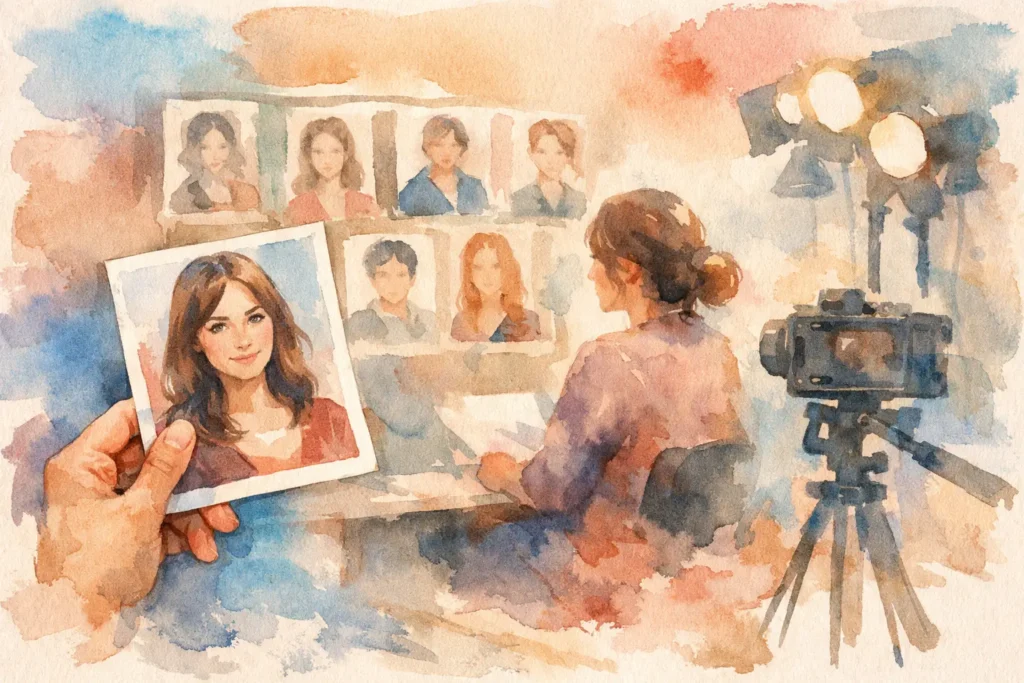
A casting office may review hundreds of submissions before lunch. In that first pass, how casting directors use headshots is not about judging whether someone is the most photogenic person in the stack. It is about finding believable possibilities for a specific role, quickly enough to keep the process moving.
Your headshot is a practical casting tool. It helps a casting director connect your name, credits, reel, and audition materials to a real person they can imagine in the world of the project. A strong image makes that connection easy. A misleading, outdated, or overly stylized one creates uncertainty before you have had a chance to show what you can do.
How casting directors use headshots in a real search
Casting is a matching process. A director may receive a breakdown that calls for a sharp young attorney, a warm neighborhood dad, a first-year teacher carrying private grief, or a founder who can command a room. The language may be broad, but the visual tone is often part of the brief.
When casting directors scan headshots, they are asking a fast series of questions: Can I see this person in the role? Do they feel right for the tone of the project? Does this image match the age range, energy, and type suggested by their submission? Is this someone I want to bring in, self-tape, or keep in mind for another role?
A headshot does not book the job on its own. Your acting, preparation, representation, materials, and the chemistry of the final cast all matter. But the photo often determines whether your submission gets enough attention to reach the next step.
That is why casting-ready does not mean generic. It means clear. The image should show your face, your present-day look, and a specific, believable point of view without trying to force a character.
They are looking for a role fit, not a label
Actors often hear the word “type” and assume it means being put in a box. In practice, type is usually a shortcut for how you may initially be perceived on screen. It can include age range, presence, emotional energy, styling, physicality, and the kinds of worlds you seem to belong in.
A casting director might respond to an image as grounded, polished, playful, intense, open, formidable, offbeat, or approachable. None of those qualities limits your range. They simply give the viewer a starting point. Once you are in the room or on tape, your work can expand the conversation.
The goal of your headshot is not to announce, “I only play this.” It is to make a truthful first impression that gives casting a useful entry point. An actor who reads as credible and available is far more helpful than an actor whose photo feels like a carefully constructed mystery.
They need to recognize you at the audition
Recognition is a basic but overlooked job of an actor headshot. If you walk into an audition looking substantially different from your photo, the casting team has to recalibrate. That may be a minor issue, but it can also interrupt the confidence created by a strong submission.
Hair length, facial hair, glasses, weight changes, and major shifts in color or styling are all reasons to reconsider your headshots. This does not mean you need a new session after every small change. It means your primary image should accurately represent the person who will appear at the audition or on a self-tape.
Current does not mean flawless. Skin texture, lines, freckles, and other real details are part of what makes an image trustworthy. Excessive retouching can remove the very character a casting office needs to see.
What makes a headshot useful to casting
Casting teams work at speed, often on small screens as well as large monitors. Your image needs to read immediately. That starts with a clean, well-lit close-up where your eyes are visible and your expression feels alive.
The strongest actor headshots tend to have a simple visual hierarchy: your face first, your eyes second, and everything else in support. Clothing, background, hair, and color should add context without competing for attention. If a viewer notices the backdrop, fashion choice, or editing style before they notice you, the image may be working too hard.
Expression matters, but there is no single correct expression. A commercial actor may need warmth and ease. A performer pursuing dramatic work may benefit from a quieter, more layered frame. Some actors need more than one look because their casting range genuinely spans different worlds. The right approach depends on the work you are pursuing and on what is true to you.
A useful headshot also leaves room for the viewer’s imagination. It should suggest a person, not lock you into a costume or a manufactured mood. Heavy props, theatrical wardrobe, extreme poses, and character makeup can make an image memorable for the wrong reason unless they are genuinely appropriate to your established market.
Why polished is not the same as overproduced
Professional lighting, thoughtful composition, and expert retouching matter. They communicate care and make it easier to see you clearly. But an actor headshot can become less effective when polish starts to replace personality.
Overly smoothed skin, dramatic color grading, overly shallow focus, or an expression that feels posed can create distance. Casting directors are not looking for an ad campaign. They are looking for the person who might walk into the room, take direction, and make a role feel real.
This is where a guided session makes a difference. Most people do not arrive knowing what their face does when they are relaxed, engaged, skeptical, or warm. Clear direction and honest feedback help you move past a fixed camera smile and find expressions that feel natural on screen.
Common headshot mistakes that create friction
The most damaging mistake is using an image that no longer looks like you. A beautiful photo from several years ago is not an asset if casting cannot recognize the person who appears on tape.
The next is sending a photo with a conflicting message. If your headshot says high-fashion editorial but your materials and casting goals are grounded television, the image may be visually impressive but strategically confusing. Your photo does not need to predict every role you can play. It should support the lane you want casting to consider first.
Another common issue is trying to cover every possible type in one frame. Actors sometimes choose a neutral expression, neutral clothing, and neutral styling because they do not want to be limited. The result can be an image with no point of view at all. A little specificity is more useful than complete blandness.
Finally, do not underestimate technical basics. Low-resolution files, awkward crops, distracting backgrounds, poor color, and images that are too dark to read on a phone can all weaken an otherwise strong submission. The image should feel professional, but the professionalism should serve clarity rather than call attention to itself.
Preparing for a more strategic headshot session
Before a session, think less about posing and more about casting context. What work are you pursuing now? Which recent roles, self-tapes, or feedback from industry professionals felt most aligned? What do people consistently respond to when they meet you?
Bring a small range of wardrobe options that fit your likely casting worlds while still looking like clothes you would actually wear. Solid colors and subtle texture often work well because they keep the attention on your face. Avoid anything that feels like a costume unless that choice is truly part of your market.
It also helps to discuss your materials honestly with your photographer. A collaborative photographer can help identify whether you need one versatile primary look or a few distinct but connected options. The answer depends on your experience, the roles you are targeting, and whether your current representation has a clear submission strategy.
At SoVane Photography, the session is built around that kind of practical conversation. The aim is not to manufacture a version of you that looks impressive for one day. It is to create real, confident images that casting can use without having to guess.
Your headshot should make the next step easier
The best actor headshot creates a small moment of confidence for the person reviewing it. Casting can see you, understand your energy, and picture where you might belong. Then they can move on to the part that matters most: your work.
If your current image feels like a past version of you, or it does not reflect the roles you want to be seen for, treat that as useful information. A thoughtful update can give casting a clearer reason to call you in and give you a more honest way to walk through the door.